

In specie is a Latin phrase meaning “in its actual form,” “in its original form,” or “as the thing itself.”
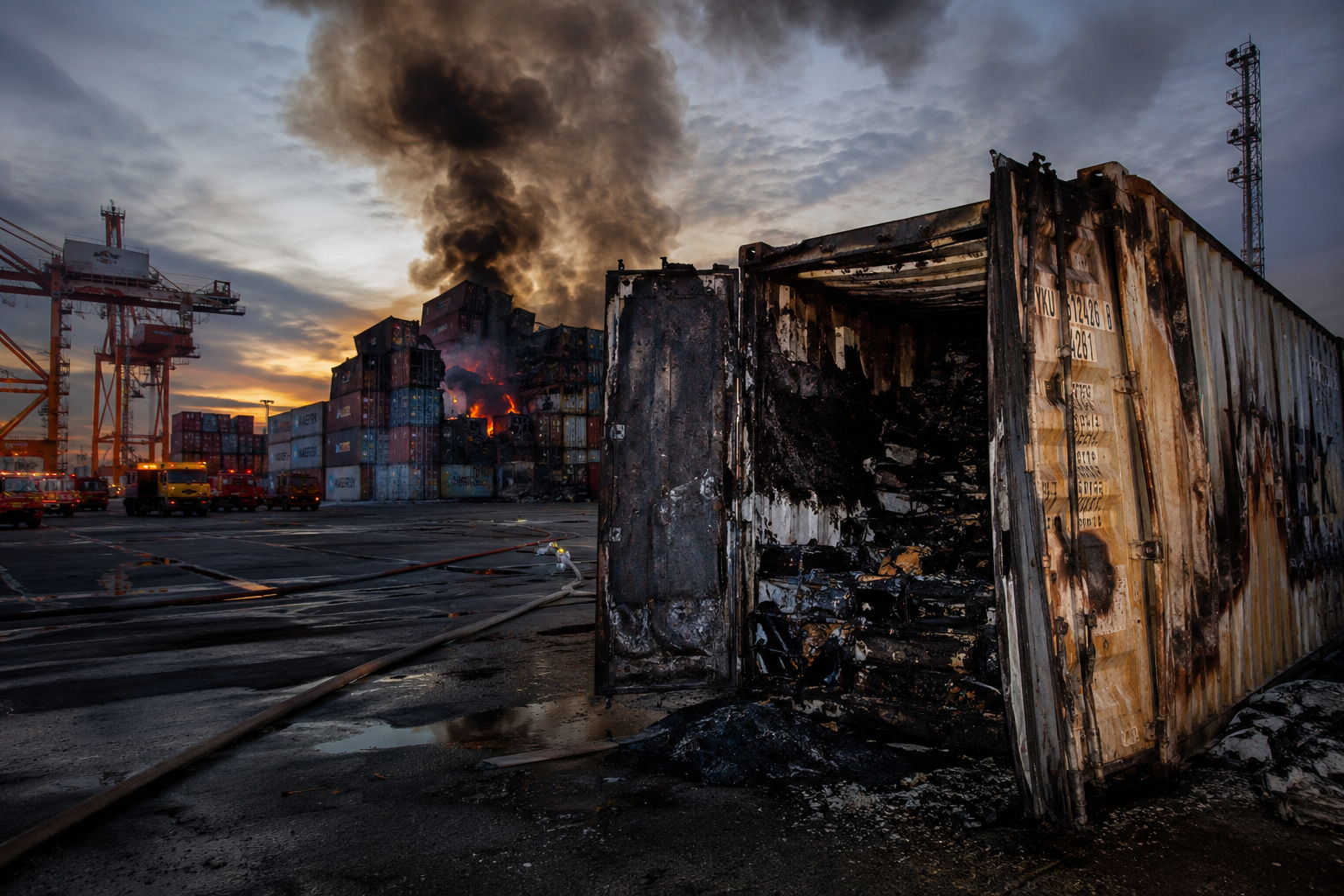
- Introduction: This article was prompted from a recent incident in which containers belonging to our clients were involved in a fire at a container terminal. As a result of the fire, both the cargo and the containers (“cargo”) themselves were rendered a total loss. Following the incident, the terminal instructed our clients to remove the damaged cargo from the terminal. Compliance with these instructions would ordinarily have required our clients to incur substantial costs, including transportation, handling, and disposali expenses. Our view was that our clients were entitled to reject the terminal’s demand to remove the cargo on the basis that it was no longer in specie following the casualty.
- Practitioners of marine insurance law will readily recall the decision in Asfar v Blundell, the principles of which are reflected in section 57(1)ii of the English Marine Insurance Act 1906. The case establishes that the “perishing” of cargo encompasses not only its physical destruction but also its commercial destruction, giving rise to a constructive total loss (“CTL”iii). It is frequently cited for the proposition that English law is concerned with the commercial identity of the goods rather than their mere physical existence. Accordingly, goods may be regarded as having perished even though they continue to exist in a physical sense and may possess some residual or salvage value, provided that they have irretrievably lost the commercial character in which they were originally entrusted to the carrier.
- What is the suggested test for cargo being in specie? We believe that one of the ways to make the determination is to ask the below questions:
- Can the damaged goods be repaired or refurbished in a commercially viable manner so that they substantially retain their original commercial identity?
- Or is the destruction of the goods irreversible such that it is mandatory to dispose of the goods?
Depending on the answers to the above questions, one would be able to glean whether the goods are in specie or not.
- Refusal: If the goods are not in specie, does this entitle cargo interests — including NVOCCs — to refuse delivery from the overlying carrier/bailee? This article is focussed more on delivery of the cargo and the associated expenses for disposal, particularly when the cargo is no longer in specie. The answer is not straightforward. It depends not merely on whether the goods have ceased to exist in specie, but also on the reason why they have lost that character.
- The legal consequences may differ depending on the circumstances that gave rise to the loss of the cargo’s commercial identity. There are two possibilities which may have caused damage to the cargo:
- No fault of the cargo interests:
- If the damage to the cargo is due to the fault of the carrier/bailee, then obviously they should bear the responsibility for the loss.
- Losses may also arise without any fault of the carrier/bailee, say by a third party, which was the case in the container fire stated in paragraph 1 above.
- If the 3rd party forms part of the carrier’s/bailee’s contractual chain, given that they selected and engaged that party, the risks should be borne by them. Even if the 3rd party is an independent party, it may still be argued that the carrier/bailee is better placed to manage operational risks arising whilst the cargo remains within their custody.
- We admit that there is paucity of case law on this aspect and therefore one needs to consider the prevailing circumstances including the contract of carriage. With respect to sea carriage, the contract of carriage would generally incorporate the Hague or the Hague Visby Rules (either by force of law or by contractual incorporation). While the Hague & Hague Visby Rules allow a carrier to both exclude and/or limit liability, they do not provide for any explicit duty requiring the cargo interests to take delivery. Should an explicit duty be provided in the contract of carriage/trading conditionsiv, the issue would be whether it is the specific cargo listed in the contract. If not (if they are no longer in specie), then we submit that the cargo interestsv would be entitled to reject delivery given that the cargo is something different from what was loaded.
- Fault of the cargo interests (including the inherent attributes of the cargo): In this case, the cargo interests should bear the risks irrespective of the fact that they do not remain in specie. Should cargo interests reject delivery, the carrier/bailee would be entitled to recover these costs and therefore, to prevent circularity of actionvi, it may be best for cargo interests to deal with the situation at hand.
- No fault of the cargo interests:
- We give below some potential scenarios to illustrate the issues at hand:
- Fire caused by an adjoining cargo and damaged the cargo/container: The cargo/container interests can refuse to take delivery if the cargo/container is no longer in specie.
- Damage to the perishable cargo in a container due to delay in the voyage:
- In this case, the cargo may no longer be saleable but the container may still be in a workable condition, albeit after removal of the spoilt cargo. The issue would be as to whether the container would be considered as being in specie given that the costs of disposal may sometimes exceed the value of the container.
- Invariably the contract of carriage would contain provisions entitling carriers to deny any liability for losses arising out of delay and/or limiting liability to the freight in question. If the delay occurred due to circumstances beyond the carrier’s control, we submit that the carrier would be entitled to deny the claim in toto. In this case, there would again be circularity of action such that cargo interests would be better off accepting delivery and dealing with the cargo.
- What if the delivery was accepted by the cargo/container interests? The cargo interests would be entitled to pursue the carrier/bailee if the damage was due to their fault. The issue would be on the costs of pursuit and the associated litigation/arbitration risks. By refusing to accept delivery of cargo no longer in specie, cargo interests are taking a tactical position to deal with their exposures for disposal of the cargo, and which the carrier/bailee may be able to defend on the basis of say limitation of liability and other provisions.
- Conclusion: Where cargo has irretrievably lost its commercial identity and no longer remains in specie, there is a principled argument that cargo interests should not be compelled to accept delivery merely to assume substantial disposal and environmental liabilities. Whether such a right exists will ultimately depend on the contract of carriage, the applicable legal regime, the cause of the loss, and the respective obligations arising under the law of contract of carriage and/or bailment.
i The costs of disposal may be substantial in some locations given that there would be requirements imposed by the authorities such as incineration to avoid any pollution.
ii 57.—(1) Where the subject-matter insured is destroyed, or so damaged as to cease to be a thing of the kind insured, or where the assured is irretrievably deprived thereof, there is an actual total loss (words in underline by us for emphasis).
iii See S 60 of the English Marine Insurance Act 1906.
iv See Clause 23 of the Singapore Logistics Association Standard Trading Conditions.
v Cargo interests include any party having an interest on the goods. In the case of shipments effected under a negotiable Bill of Lading, the consignee or holder of the Bill of Lading only becomes liable should they come forth to take delivery or initiate a claim against the Carrier. If the consignee is aware that the cargo is no longer in specie, they may not come forth to take delivery. This does not however prevent the Carrier from pursuing the Shipper, the original party listed in the Bill of Lading (See S3(1) of the English COGSA 1992 and the Singapore Bills of Lading Act 1992).
vi Circularity of action is a common law doctrine that refers to a situation where one legal action would inevitably be followed by another action that produces the opposite financial result, making the litigation pointless.


3 cosas: El riesgo de la mercadería recae en una de las partes según el INCOTERM elegido. El acuerdo de servicio de transporte es entre el cargador (puede ser el vendedor) y el transportista o NVOCC. El contrato de transporte es uno a favor de tercero, donde el tercero es el consignatario. En base a eso, si llega el bien con PTC, el riesgo de enviar otro en reemplazo lo asume el comprador o vendedor según INCOTERM. Ej. si fuera FOB o CIF, CIP, el riesgo es del adquirente. Este rechaza la mercancía en tanto le deben enviar otra. Si fuera un INCOTERM como DPT donde el adquirente asume el riesgo, de rechazar el bien, para tener la reparación del seguro, el bien pasaría al Asegurador. La terminal trasladará los costos a consignatario normalmente, pero debe esclarecerse que al haber PTC el seguro se haría cargo de eso. Puede obligarse al consignatario a abonar?, él no es parte del acuerdo de transporte sino beneficiario. Es más probable que si el consignatario, usuario final de la terminal, no lo pague, se lo requieran al transportista, usuario del terminal, y éste lo requiera al cargador según las cláusulas pactadas o a la Aseguradora que cubra el riesgo de la travesía.
Responder
Carmen Quevedo
·
3 ideas: The risk of the goods falls on one of the parties of the purchase contract, according to the chosen INCOTERM. The transport service agreement is between the shipper (which can be the seller) and the carrier or NVOCC. The transport contract is for the benefit of a third party, where the third party is the consignee. Based on those, if the goods arrive damaged, the risk of sending a replacement one that is assumed by the buyer or seller according to the INCOTERM. For example, if it were FOB or CIF, CIP, the risk is on the buyer. They reject the goods as long as they are owed a replacement. If it were an INCOTERM like DPT where the buyer assumes the risk, upon rejecting the goods, to claim insurance, the goods would go to the insurer. The terminal will normally pass the costs on to the consignee, but it should be clarified that if there is Total Constructive Loss, the insurance would cover that, then it has the role of the beneficiary. If it want to pick the remaining goods, it will have to assume that cost. Can the consignee y himself be required to pay? He is not part of the freight agreement, just the beneficiary. It’s more likely that if the consignee -, the terminal’s end user- doesn’t pay, the terminal will require it from the carrier, the terminal main user, who in turn would claim it from the shipper according to the agreed clauses of the contract or from the insurer covering the voyage risk.