
Insurance Coverage Gaps against Emerging Risks?
- We recently attended the 11th Asian Maritime Law Conference (AMLC) 2026, held in Singapore on 14th October 2026. The conference provided an excellent forum to reconnect with colleagues and exchange views on topical legal and claims issues affecting the industry. The keynote address was delivered by The Honourable Justice S Mohan, who spoke on “In the Wake of Hin Leong Trading: Significant Maritime Decisions in Singapore”, highlighting key court decisions and their practical commercial consequences. Beyond case law, several sessions addressed how standard insurance wordings were being tested by modern technical and geopolitical perils. We share our thoughts on the coverage issues and our review of the differences in the cover provided by Transport Liability Insurers for War Risks.
- Cyber
- During the session on the Impact of Modern Cybersecurity on the Maritime Industry and Legal Practice, Mr Dominic Wong of Specialist Risk Group addressed an area of growing concern: the mismatch between standard Hull & Machinery (H&M) cyber exclusions and market buy-back covers.
- Conventional H&M wordings routinely exclude cyber risks by incorporating a Marine Cyber Endorsement. To mitigate this, shipowners frequently purchase separate cyber extensions or buy-back endorsements. Many standard buy-backs are designed primarily for non-physical cyber losses (such as extortion, system restoration, or business interruption) and specifically exclude physical loss of or damage to the vessel resulting from a cyber-attack.
- Consider a scenario where a malware infection compromises an electronic chart display or vessel automation system, resulting in an errant helm input and subsequent collision or grounding. While the shipowner might recover digital investigation expenses under a cyber add-on, the resulting physical hull damage could remain uninsured under both the primary H&M policy and the buy-back endorsement.
- Specialist marine insurers1 do write covers intended to bridge this divide. The practical lesson for shipowners and their brokers is to conduct a clause-by-clause audit: map the exact reach of the primary policy’s cyber exclusion against the reinstatement scope of the buy-back cover, ensuring that consequential physical damage is not inadvertently left uncovered.
- War Risks – Do some Transport Liability Policies Over-Exclude?
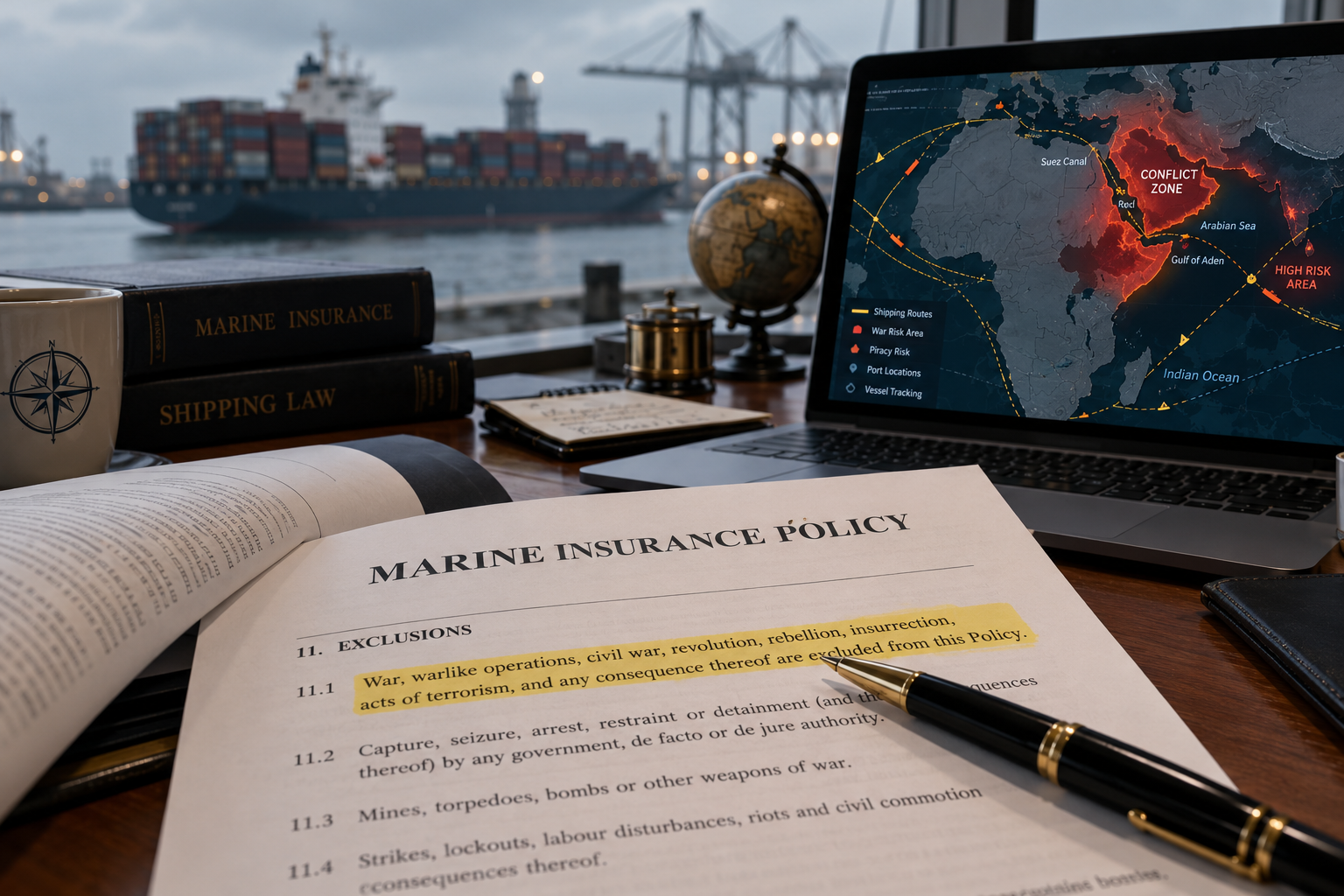
- With geopolitical conflicts continuing and Listed Areas designated by the Joint War Committee (JWC) frequently expanding, shipowners and charterers are accustomed to paying Additional Premiums (AP) to maintain war cover. A less examined but equally vital issue is: How do War Risks exclusions operate under Transport Operators’ Liability policies2?
- Unlike property insurance (which provides first-party indemnity for damaged physical assets), transport liability insurance covers an Operator’s3 legal and contractual liabilities to third parties. In maritime and multimodal transit, an operator generally has recognized legal defences – such as provided in the Operator’s Standard Trading Conditions4 including force majeure, statutory defences including the Hague/Hague-Visby Rules Article IV Rule 2(e) (“Act of war”) – where a loss arises from hostilities without fault or negligence by the Operator or Rule 2(q) – any other cause arising without the actual fault or privity of the carrier….
- This difference between property and liability exposures highlights why exclusion clauses must be drafted with precision:
- Property vs. Liability Exposures: Where an Operator insures carrying equipment (such as owned or leased containers and chassis) against physical loss or damage, a specific war risk exclusion is understandable and for which a buy back cover can be purchased by payment of an Additional Premium (“AP”). Where an Operator faces a cargo claim arising from the war-like situation, it may find that notwithstanding the existence of a valid defence, the War Risks exclusion operates to deny cover not only for the underlying liability but also for the costs which may be incurred in defending the claim.
- The market approach to this issue is notably divided:
- TT Club 2026 Transport and Logistics Operators (TLO) Policy: The General Exclusions (Section G1) do not incorporate a blanket war exclusion across the entire policy. Instead, war exclusions are confined to specific property extensions5, such as Section A11 (Carrying Equipment, Clause 5). This structure preserves liability indemnity while excluding first-party war perils on physical assets.
- ATLAS Freight Forwarders Liability Policy (2017) & Freeboard Maritime Cargo Liability Policy (2023, v1.1): In contrast, these policy wordings incorporate general War Risks exclusions within their General Exclusions (Clause 41 and Clause 3.21 respectively) potentially extending their application across the various liability covers provided. Accordingly, when an Operator faces a claim arising from a war-related incident, insurers may be entitled to decline indemnity by relying on the applicable War Risks exclusion, even though the Operator has a valid defence under its contract or applicable law. Although the Operator may ultimately succeed in defending the claim, it would nevertheless incur substantial legal costs which may also fall outside the scope of its insurance cover. To address this potential gap, Transport Operators may wish to consider negotiating a specific buy-back of the War Risks exclusion against payment of an Additional Premium (AP). Alternatively, they could explore arranging Freight, Demurrage and Defence (FD&D) cover, which may provide financial assistance towards the legal costs of pursuing or defending maritime and contractual disputes that are not covered under their existing liability policies. The key consideration should be to ensure that the Operator is not inadvertently left uninsured for both the underlying liability and the costs of defending a claim arising from war-related events.
- Takeaways for Operators: Given current transit complexities, Operators should review their policy wordings to determine:
- Whether war exclusions apply as an overarching general exclusion or are restricted solely to direct property/equipment sections.
- Whether the policy continues to respond when the claim is founded upon the Operator’s alleged negligence or operational default, despite the background presence of war-related perils.
- If underwriters insist on a policy-wide war exclusion, whether an appropriate liability buy-back endorsement can be agreed upon payment of an Additional Premium (AP) or other covers such as FD&D.
- Risk Mapping
- No insurance policy covers every conceivable risk, nor is it commercially viable to eliminate all exposure through insurance alone. Insurance represents only one arm of sound risk management.
- True protection requires continuous risk mapping, which includes:
- Evaluating actual trade lanes and operating conditions against policy exclusions.
- Ensuring back-to-back symmetry wherever possible between commercial contracts (e.g., standard trading conditions or bills of lading terms and conditions) and underlying liability insurances.
- Imposing strict exposure limits on cargo and equipment accumulated in exposed terminals, ports, and transit corridors (maximum amount in any one bottom or location).
- Risk mapping is an ongoing operational exercise. As contractual liabilities, technology, and regional perils evolve, an Operator must continue to review his risks including the available insurance covers to protect their exposures.
1. For instance, cover provided by Beazley’s and The Swedish Club.
2. Provided by Through Transport Club – Transport and Logistics Operators and other specialist insurers such as ACIS, Freeboard Maritime, Markel, etc.
3. Includes a Freight Forwarder acting either as Agent or as Carrier (NVOCC).
4. For instance, Singapore Logistics Association or the British International Freight Association Standard Trading Conditions as incorporated in the contract with their clients.
5. TT Club in their advisory state that Liability claims under the Cargo Liabilities (T1), Errors and Omissions (T2), Third‑Party Liabilities (T3), Fines and Duties (T4), and Costs (T5) clauses are not subject to war risks exclusion or the recent Notice of Cancellation. Cover under these sections will continue to respond in the usual manner, subject to the terms and conditions of the individual certificate of insurance and policy wordings.