


Arbitration for Malaysian Logistics Service Providers
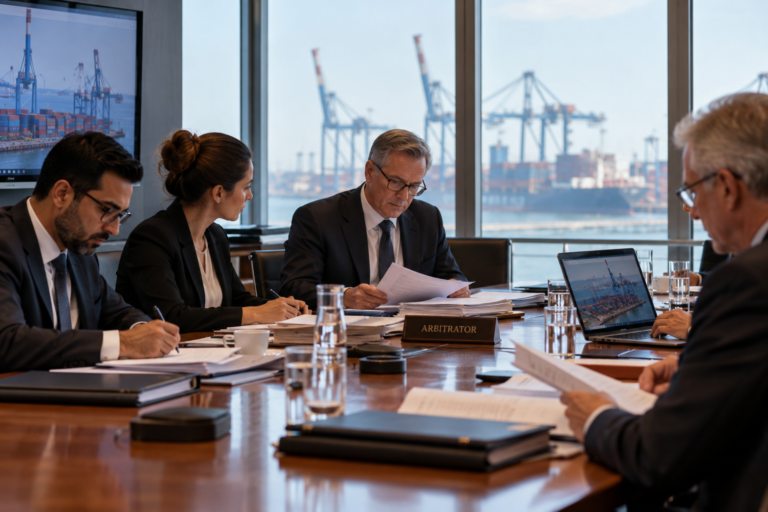
- We recently had the opportunity to attend the Callidus Evening Talk held in Shah Alam, Malaysia. It was a pleasure to reconnect with old friends, make new acquaintances and, at the same time, hear about recent developments in the industry1. One of the topics discussed during the evening was Dispute Resolution in the Maritime Arena, with particular focus on the lifecycle of trading and chartering disputes and the use of AIAC arbitration. While large maritime and trading disputes naturally attract considerable attention, arbitration can be equally relevant to the more routine disputes encountered by logistics service providers (“LSPs”). In this article, we consider whether arbitration should play a greater role as a dispute resolution mechanism within the Malaysian logistics industry2.
- LSPs invariably contract on the basis of Standard Trading Conditions (“STCs”)3.
- These terms commonly allow an LSP to exclude or limit its liability, claim interest on overdue payments, exercise a general lien over cargo for outstanding sums, and terminate its engagement in circumstances such as material breach or failure by the customer to provide necessary instructions.
- Liability insurers covering LSPs will also generally expect their insureds to contract on terms that are either widely recognised within the industry4 or have otherwise been reviewed and approved by the insurers.
- The STCs5 presently in use in Malaysia generally provide for disputes to be submitted to the jurisdiction of the courts at the place where the LSP is established6. In our view, there is merit in considering whether such provisions should instead provide for arbitration7, or at least offer arbitration as an alternative dispute resolution mechanism.
- One particular advantage of arbitration8 is the ability of the parties to appoint a tribunal with appropriate industry, legal and technical expertise. Logistics disputes frequently involve questions concerning freight forwarding practices, documentation, cargo handling, warehousing, customs formalities, multimodal transport and other established trade practices. A tribunal familiar with these matters may be better placed to understand the commercial context of the dispute and deal efficiently with the issues before it.
- The same consideration applies where an LSP contracts as carrier and issue their Bills of Lading (“B/L”). An appropriately drafted arbitration clause may provide a practical means of resolving disputes arising under such B/L’s, particularly where the carriage is international and the parties, cargo interests and service providers may be located in different jurisdictions. We have previously discussed this issue in Arbitration for Liner Bills of Lading and Arbitration Clause – Liner Bills of Lading, and therefore will not repeat those observations here.
- Datuk Danesh Chandran, Chief Executive Officer of the Asian International Arbitration Centre (“AIAC”), was one of the speakers at the event and highlighted the benefits of both arbitration and mediation, as well as the use of the AIAC Rules. As one of Malaysia’s leading alternative dispute resolution institutions, AIAC is well placed to work with Malaysian logistics associations and industry stakeholders to develop model dispute resolution clauses specifically suited to logistics contracts, including STCs, Bills of Lading, warehousing agreements and other commonly used trade documents. There may also be merit in considering whether the existing AIAC procedures could be further streamlined for logistics-related claims9. Many such disputes are relatively modest in value but involve specialised industry issues. An expedited, cost-effective procedure, coupled with the ability to appoint arbitrators familiar with logistics and transport practices, could make arbitration considerably more attractive to the industry.
- Ultimately, arbitration should not be viewed as being reserved for substantial charterparty or international trade disputes. Properly structured, it can also provide Malaysian LSPs with a specialised, neutral and commercially focused forum for resolving the everyday disputes that arise in the logistics business.
1 We thank Joy Thattil for organising the event ably supported by his colleagues Megha and Ooi Wei Qian.
2 See our earlier article, Logistics Contracts – Arbitration.
3 See for instance the Federation of Malaysian Freight Forwarders Standard Trading Conditions and which is commonly used by LSP’s in Malaysia.
4 Use of FMFF STC’s would be considered as standard industry terms in Malaysia.
5 See our earlier article, STC – Logistics Service Providers.
6 See Clause 43 of the FMFF STC. In this regard, Clause of the BIFFA STC does provide for arbitration as one of the dispute resolution process to deal with disputes.
7 See our earlier article, Logistics Contracts – Arbitration.
8 One of the comments made by one of the speakers is that it may sometimes be difficult to convince the court on the established practices in the industry. This being the case, arbitration may be better suited for industries which have their own established customary practices.
9 The AIAC Rules do allow for Fast Track Procedures for both domestic and international arbitration. Given that LSP’s may also be contracting with international parties, we would suggest a single procedure to be used for both domestic and international arbitration.


A very informative article on the arbitration process for resolving maritime and logistics disputes, with a particular emphasis on the role of AIAC as one of Malaysia’s leading alternative dispute resolution institutions.