
- We recently came across two interesting papers presented at the 51st Annual Conference of the Maritime Law Association of Australia and New Zealand (MLAANZ):
- “All at Sea: Can you contract out of the extended period of responsibility under the Australian Hague-Visby Rules?” by Geoff Farnsworth and Jonathon Parkin.
- “War Risks: Dealing with the Gulf” by Matthew Harvey KC.
We also revisited Justice Angus Stewart’s1 2019 Richard Cooper Memorial Lecture on “The Fluctuating incidence of the burden of proof under the Hague-Visby Rules: the implications of Volcafe v CSAV [2019] AC 358 for the position in Australia”. Australian maritime lawyers and judges continue to make significant contributions to the development of maritime law. Our pet peeve, however, remains section 11 of the Australian Carriage of Goods by Sea Act 1991 (COGSA), which restricts the enforceability of foreign jurisdiction and arbitration clauses in certain sea carriage documents.
- In this article, we focus on the first paper and consider its implications for container carriers, cargo interests and their respective insurers. Australia is unusual among Hague-Visby Rules jurisdictions in that it has extended the carrier’s period of responsibility beyond the traditional “tackle-to-tackle” period. This raises an interesting question: Does a CY/CY notation on a bill of lading necessarily mean that the carrier is responsible for the cargo throughout that period?
- The Australian Position – Extended period of responsibility:
- Under the Australian COGSA, the carrier’s period of responsibility extends beyond loading and discharge. Broadly, it commences when the goods are delivered to the carrier within the limits of the load port and ends when the goods are delivered to the consignee within the limits of the discharge port. The practical implications may be less pronounced for bulk cargo shipments, particularly where loading and discharge responsibilities are allocated to the shipper and consignee under Free In and Out (FIO) terms. Containerised shipments, however, present a different situation.
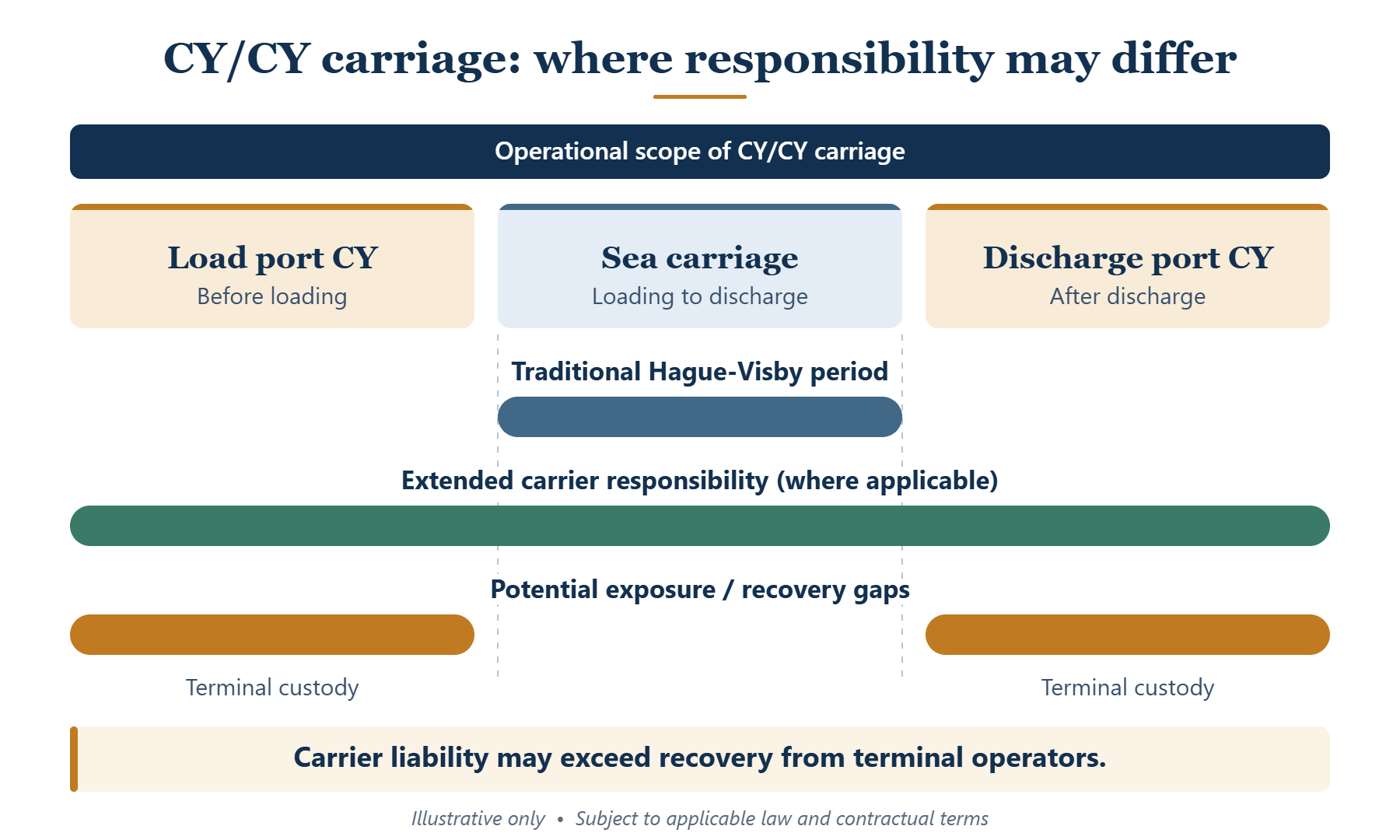
- At the load port, laden containers are generally delivered to the Container Yard (CY) before the vessel arrives. They are stored at the CY and subsequently moved within the terminal for loading onto the vessel by the terminal operator. Similarly, at the discharge port, the terminal operator moves the containers from the vessel to the CY, where they are stored pending collection by the consignee. There is, therefore, a period both before loading and after discharge during which the containers are in the custody of terminal operators.
- The authors of the MLAANZ paper consider three possible interpretations of the extended period of responsibility under the Australian COGSA. We favour their third interpretation i.e. that the Australian legislation overrides Art VII of the HV Rules, which would otherwise allow carriers to contractually exclude or limit liability before loading and after discharge.
- The liability gap between carriers and terminal operators:
- An important issue arising from the extended period of responsibility is whether the carrier’s liability to cargo interests is matched by its ability to recover from the terminal operator responsible for the loss. Our review of Australian terminal services terms and conditions indicates that terminal operators may limit their liability for cargo damage. Examples include limitations of SDR 2 per kilogram and A$100,000 for goods in a container, depending on the applicable terms2. This could result in a situation where the carrier is liable to cargo interests for an amount greater than what it can recover from the terminal operator. The difficulty is further compounded by the limited choice of terminal operators available to container carriers at certain ports. Given the relative bargaining strength of terminal operators, carriers may find it difficult to negotiate back-to-back liability provisions3.
- Container carriers and their insurers should be aware of this potential gap and, wherever possible, seek to align their contractual liabilities with those of their service providers4. In the interests of fairness, we believe there is merit in considering whether third parties engaged by carriers during the extended period of responsibility should be subject to a comparable statutory liability regime.
- CY/CY Carriage – What does it mean?
Container shipments are commonly undertaken on a CY/CY basis. This generally means that the shipper delivers the laden container at the container yard at the load port, and the consignee collects the container from the container yard at the discharge port. Bills of lading (“BL”) generally provide for the application of the Hague or Hague-Visby Rules, either by operation of law or through contractual incorporation, typically by a Clause Paramount. However, does the CY/CY notation on the face of the bill of lading mean that these Rules apply throughout the entire CY/CY period? The answer depends on the applicable law and the terms and conditions of the BL.- BL wordings: Our review of various container carriers’ bills of lading suggests that there are broadly two approaches to defining the carrier’s period of responsibility:
- Extended period of responsibility. Certain carriers, including Maersk5, ONE, COSCO and Evergreen, use wordings which generally extend their contractual period of responsibility beyond loading and discharge and when the cargo is under the Carrier’s control i.e. after tendering of cargo till released.
- Restrictive period of responsibility. Other carriers, including MSC6, CMA CGM, Hapag-Lloyd and NVOCCs using the TT Series 1007 wording, adopt provisions which generally restrict the carrier’s responsibility for port-to-port carriage to the period between loading and discharge. The distinction is important. Although both types of bills of lading may provide for CY/CY carriage, the carrier’s legal responsibility may differ considerably. The precise liability regime applicable during the extended period must also be considered. An extension of the carrier’s period of responsibility does not necessarily mean that all provisions of the Hague-Visby Rules apply throughout that period.
- Time bar: A separate issue is the time bar applicable to claims arising before loading or after discharge. Although some restrictive bill of lading wordings limit the carrier’s period of responsibility to loading and discharge, this does not necessarily mean that the one-year time bar under the Hague or Hague-Visby Rules is inapplicable outside that period. In FIMBank plc v KCH Shipping Co Ltd [2024] UKSC 38, the UK Supreme Court confirmed that the one-year time bar applies to misdelivery occurring after discharge. It would however be incorrect to apply the English decision for all mis-delivery claims given that the eventual decision would depend on the jurisdiction where this is being tried8 and the law of the contract. It is also our view that perhaps the issue of “comity of nations” was not considered in the English Judgement.
- Recovery against terminal operators:
- Where cargo loss or damage occurs before loading or after discharge, carriers using restrictive wordings may seek to deny liability, provided the applicable law permits them to do so. Depending on the contractual arrangements, the carrier may contend that it was acting as an agent for cargo interests in arranging the relevant terminal services.
- Cargo interests may then have to consider pursuing a claim directly against the terminal operator. However, such recovery may be subject to several restrictions, including:
- The applicability of the Himalaya Clause, which may extend the carrier’s contractual protections to its servants, agents and subcontractors.
- Any applicable contractual limitations or exclusions of liability.
- No-claim and indemnity provisions contained in the bill of lading.
- A further question is whether the terminal operator can seek an indemnity from the carrier for any liability incurred. This would depend principally on the terms of the Terminal Services Agreement between the carrier and the terminal operator9.
- BL wordings: Our review of various container carriers’ bills of lading suggests that there are broadly two approaches to defining the carrier’s period of responsibility:
- Conclusion: Who bears the risk? A CY/CY notation on the face of a bill of lading should not automatically be interpreted as extending the carrier’s legal responsibility throughout the CY/CY period. The following considerations are particularly relevant:
- Cargo interests:
- The carrier’s responsibility may not extend to the entire CY/CY period unless provided for by the applicable law or the terms of the bill of lading.
- Recovery for losses occurring before loading or after discharge may be subject to different liability regimes and potentially lower limits of liability.
- Direct recovery from terminal operators may also be subject to contractual restrictions and defences.
- Container Carriers
- Carriers using extended liability wordings may find themselves exposed to a gap between their liability to cargo interests and their recovery from terminal operators.
- Carriers operating in jurisdictions where the period of responsibility is extended by statute may face a similar exposure, irrespective of their standard bill of lading wording.
- Wherever commercially possible, carriers should seek back-to-back liability provisions in their Terminal Services Agreements.
- Insurers (both cargo and carrier liability)
- Insurers should recognise that a carrier’s liability during the extended period may not be matched by an equivalent right of recovery against the terminal operator.
- The potential gap should be considered when assessing the carrier’s contractual exposures.
- Cargo interests:
Ultimately, while CY/CY describes the agreed operational scope of carriage, it does not necessarily define the carrier’s legal period of responsibility. The distinction between the two, and the resulting liability gap, deserves greater attention from carriers, cargo interests and their respective insurers.
1. Justice Stewart’s other papers are available at https://www.fedcourt.gov.au/digital-law-library/judges-speeches/justice-stewart
3. It would be difficult for carrier’s to negotiate with the Terminals seeking a back-to-back limitation of liability provisions as available under the Hague Visby Rules given the Terminals bargaining power, but it is worth attempting on renewal.
4. The 1991 UN Convention on the Liability of Operators of Transport Terminals in International Trade (the OTT Convention) never came into force. The Rotterdam Rules, though also not yet in force, offer a possible model. By treating terminal operators as “maritime performing parties”, the Rules would make them subject to the same liability regime as the carrier, closing the very gap identified above.
5. Clause 5.1 of the Maersk BL terms and conditions state “Where the Carriage is Ocean Transport, the Carrier undertakes to perform and/or in his own name to procure performance of the Carriage from the Port of Loading to the Port of Discharge. The liability of the Carrier for loss of or damage to the Goods occurring between the time of acceptance by the Carrier of custody of the Goods at the Port of Loading and the time of the Carrier tendering the Goods for delivery at the Port of Discharge shall be determined in accordance with Articles 1-8 of the Hague Rules save as is otherwise provided in these Terms and Conditions. These articles of the Hague Rules shall apply as a matter of contract”. The wordings apply the Hague Rules package limit and which sometimes may be below the limitation available under the HV Rules.
6. MSC BL Terms and conditions: Clause 4.1 on sub-contracting – The Carrier shall be entitled to sub-contract on any terms whatsoever the whole or any part of the carriage, including liberty to further sub-contract. Clause 4.2 on indemnity – The Merchant undertakes that no claim or allegation whether arising in contract, bailment, tort or otherwise shall be made against any servant, agent, or Subcontractor of the Carrier which imposes or attempts to impose upon any of them or any Vessel owned or chartered by any of them any liability whatsoever in connection with the Goods or the carriage of the Goods whether or not arising out of negligence on the part of such Person. If any such claim or allegation should nevertheless be made, the Merchant agrees to indemnify the Carrier against all consequences thereof. Without prejudice to the foregoing, every such servant, agent and Subcontractor shall have the benefit of all terms and conditions of whatsoever nature contained herein or otherwise benefiting the Carrier under this Bill of Lading, as if such terms and conditions were expressly for their benefit. In entering into this contract, the Carrier, to the extent of such terms and conditions, does so on its own behalf and also as agent and trustee for such servants, agents, and Subcontractors.
Clause 5.1 for Port-to-Port carriage – If carriage under this Bill of Lading is Port-to-Port the period of responsibility of the Carrier for any loss of or damage to the Goods shall commence only at the moment that the Goods are loaded on board the Vessel and shall end when the Goods have been discharged from the Vessel. Clause 10.2 for Time bar – In any event, the Carrier shall be discharged from all liability if suit is not commenced within one (1) year after delivery of the Goods or the date that the Goods should have been delivered for claims related to loss or damage during the Port-to-Port carriage, and for claims related to loss or damage during Inland Transport the shorter of nine (9) months or any time limit provided for by any applicable international convention, national law, regulation or contract by virtue of clauses 5.2.2 (a) or (b).
7. Clause 5(1) on sub-contracting: The Carrier shall be entitled to sub-contract on any terms whatsoever the whole or any part of the Carriage. Clause 5(2) on Indemnity: The Merchant undertakes that no claim or allegation shall be made against any Person or Vessel whatsoever, other than the Carrier, including, but not limited to, the Carrier’s servants or agents any independent contractor and his servants or agents, and all others by whom the whole or any part of the Carriage, whether directly or indirectly, is procured, performed or undertaken, which imposes or attempts to impose upon any such Person or Vessel any liability whatsoever in connection with the Goods or the Carriage of the Goods, whether or not arising in contract, bailment, tort, negligence, breach of express or implied warranty or otherwise; and if any claim or allegation should nevertheless be made to Indemnify the Carrier against all consequences thereof. … 6 (1)(A) of Carrier’s responsibility on Port to Port Shipment: Where the Carriage is Port to Port, then the liability (if any) of the Carrier for loss or damage to the Goods occurring between the time of loading at the Port of Loading and the time of discharge at the Port of Delivery shall be determined in accordance with any national law making the Hague Rules, Hague-Visby Rules, COGSA or any other rules compulsorily applicable to this bill of lading or in any other case in accordance with the Hague Rules Article 1-8 inclusive (excluding Article 3 rule 8) only. 6(F) on Time Bar: The Carrier shall be discharged of all liability whatsoever in respect of the Goods unless suit is brought in the proper forum and written notice thereof received by the Carrier: (i) within nine months in respect of Combined Transport or (ii) within 12 months in respect of Port-to-Port Shipment after delivery of the Goods or the date when the Goods should have been delivered. In the event that such time period shall be found contrary to any convention or law compulsorily applicable, the period prescribed by such convention or law shall then apply but in that circumstance only.
8. See our earlier articles, Mis-delivery of cargo – Time bar and Mis-delivery of cargo – Time bar -2.
9. In this case, given that there is no direct contract between the terminal and the cargo interests, cargo interests should be able to recover for the full value of the cargo. However, due to the application of the Himalaya Clause(Clause 4.2 of the MSC & Clause 5.2 of the TT Series 100 B/L) coupled with an express provision for the application of contractual liability limits provided in the BL, terminal operators would be entitled to generally limit liability to a figure no higher than the HV Rules.
More on this topic: Container Shipping & Cargo Claims · All Nau Newsletter articles